
The two main neuropathologic findings in Parkinson disease include:
- Loss of pigmented dopaminergic substantia nigra neurons.
- The presence of Lewy bodies
The loss of the dopaminergic neurons occurs mostly in the ventral lateral area of the substantia nigra. Although it is the loss of dopaminergic neurones that causes signs and symptoms of the disease, approximately 60-80% of the neurons must be lost before the motor signs of Parkinson disease emerge.
The basal ganglia motor circuit is the main modulator of cortical output necessary for normal smooth body movements
Action potentials originating from the cerebral cortex are processed through the basal ganglia-thalamocortical motor circuit and return to the same area of the cortex via a feedback pathway. Output from the motor circuit is directed through the globus paladius interna (GPi) and the substantia nigra pars reticulata (SNr). This inhibitory output is directed from both of these areas to the thalamocortical pathway and suppresses movement via GABAergic neurones.
There are two pathways within the basal ganglia circuit, these are the direct and indirect pathways:
· In the direct pathway, output from the striatum directly inhibits GPi and SNr, using GABA as a neurotransmitter. Striatal neurons contain D1 receptors and constitute the direct pathway and project to the GPi/SNr.
· The indirect pathway contains inhibitory connections between the striatum and the globus paladius externa GPe and between the GPe and the subthalamic nucleus (STN). Striatal neurons containing D2 receptors are part of the indirect pathway and project to the GPe.
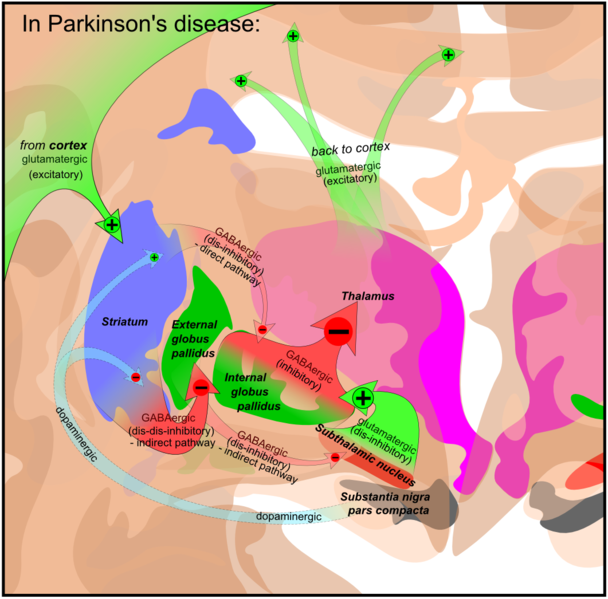
Image courtesy of https://commons.wikimedia.org/wiki/File:Basal_ganglia_in_Parkinson%27s_disease.png?uselang=en-gb
The Sub thalamic nucleus is the mojor regulator of the pathway. It causes an excitatory influence on the GPi and SNr by using glutamate as it’s neurotransmitter. The GPi/SNr sends inhibitory output to the ventral lateral nucleus (VL) of the thalamus using GABA as a neurotransmiter. Dopamine is released from nigrostriatal (SNc) neurons activating the direct pathway via D1 receptor and inhibiting the indirect pathway via the D2 receptor. In Parkinson disease, a decrease in substantia nigra (pars compacta) dopamine production means less activation of D1/2 receptors in the corpus striatum. This causes an increased inhibition of the thalamocortical pathway through the two major pathways in the basal ganglia circuit. In the direct pathway, decreased striatal dopamine stimulation causes decreased inhibition of the GPi/SNr meaning and increase inhibition is relayed to the VL nucleus. Via the indirect pathway, decreased dopamine inhibition causes increased inhibition of the GPe, resulting in activation of the STN. Increased STN output increases GPi/SNr inhibitory output to the VL nucleus of the thalamus. Both pathways, in turn, lead to a decrease in glutameatergic signals being sent to the motor cortex which ultimately leads to the primary symptoms of parkinson’s disease including tremor at rest, muscle rigidity and suppression of voluntary movements (hypokinesis).